 By
By
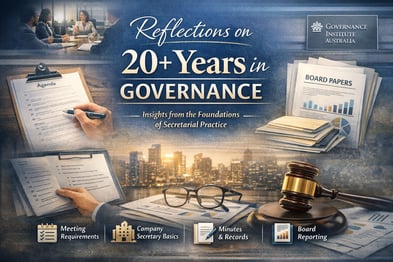 Over the past five weeks, I’ve been sharing reflections on my journey through formal governance study and decades of practical experience in Board Secretary and senior administrative roles. Early 2025, I completed the Certificate in Foundations of Secretarial Practice with the Governance Institute of Australia. For me, this wasn’t simply a box to tick, it was an opportunity to consolidate experience, formalise best practices, and reflect on what makes governance truly effective.
The program focused on four pillars that now underpin my governance practice:
 Essentials of Meeting Requirements
- The Accidental Company Secretary
- Minutes for Boards and Committees
- Board Papers and Reporting Essentials
Each module offered both technical frameworks and a lens through which to examine how my work, whether supporting boards, executives, or running my own business, impacts organisational accountability, risk, and success.
Essentials of Meeting Requirements: Governance in Motion
Meetings are the heartbeat of governance. When structured correctly, with clear purpose, authority, and follow-up, they enable directors to act confidently and decisively. Poorly prepared meetings, on the other hand, can lead to confusion, blurred responsibilities, and even disputes.
Through formal study and mentorship, I deepened my understanding of why notice periods, agendas, authority structures, and follow-ups exist, not as red tape, but as mechanisms to protect decision-making integrity. This perspective shapes every board session, executive briefing, and internal meeting I coordinate today.
For Executive Assistants, mastering meeting requirements is career-defining. It elevates the role from organiser to strategic governance partner, ensuring every meeting strengthens clarity, accountability, and trust.
The Accidental Company Secretary: Embracing the Fundamentals
Many Company Secretaries, including myself, enter the role “by accident” trusted and capable, yet without formal training. Early reliance on experience and intuition served well but left gaps in governance fundamentals.
This module reinforced the importance of understanding corporate structures, regulatory obligations, director duties, and the legal standing of the Company Secretary. Without these foundations, even highly capable administrators can inadvertently expose directors and organisations to risk.
Mentorship was critical, guiding me to move beyond “this is how it’s always been done” toward actions that are defensible, compliant, and strategically aligned. For Executive Assistants, this knowledge transforms the role — enabling anticipation of issues, confident executive support, and informed decision-making.
Minutes for Boards and Committees: The Quiet Backbone of Governance
Minutes are often misunderstood as administrative tasks, but they are far more: legal records, governance tools, and risk management instruments. Clear, impartial, and structured minute-taking safeguards directors and organisations alike. Poorly documented decisions, conversely, can quietly sow conflict.
Through study and mentorship, I refined my approach to capturing resolutions, discussions, conflicts of interest, and director declarations. These skills are transferable across board, committee, and executive contexts and in my own business, they ensure accountability, continuity, and defensible decisions.
Strong minute practices are silent protectors of governance. They maintain trust, prevent disputes, and provide the foundation for confident leadership.
Board Papers and Reporting Essentials: Clarity Enables Confident Decisions
Good governance requires good information. Board papers are the bridge between management and decision-makers, and their quality directly impacts decision-making effectiveness.
This module reinforced that effective reports are concise, relevant, and decision-ready, highlighting risks, implications, and alternatives without overwhelming the reader. Weak reporting, I’ve observed, leads to deferred decisions, misaligned expectations, and tension between boards and executives.
For Executive Assistants, mastering board papers is a strategic differentiator. Clear reporting translates across any business context, enabling confident leadership, robust decision-making, and organisational resilience.
Reflections and Lessons Learned
Completing this certification validated decades of experience while formalising frameworks that underpin strong governance. Key lessons include:
- Governance is active, not passive: Every meeting, paper, and minute matters.
- Mentorship is invaluable: Guidance pushes you to apply rigour, ask critical questions, and think strategically.
- EA skills intersect with governance: Structuring information, anticipating needs, and documenting decisions are critical across boards, executives, and business operations.
- Robust systems prevent disputes: Clarity in meetings, minutes, and reporting protects directors and supports organisational integrity.
Ultimately, governance foundations matter. They provide confidence, clarity, and peace of mind for boards, executives, and organisations alike. At Vershaw, our focus is not only on administrative support but on creating stability, strategic insight, and leadership confidence — without the need for a full-time hire.
Governance is more than compliance; it is the backbone of effective leadership, robust decision-making, and organisational success.
- Alex
- The Accidental Company Secretary
- Minutes for Boards and Committees
- Board Papers and Reporting Essentials
- The Essentials of Meetings
- How AI is Tranforming Board Governance
- Foundations in Governance